
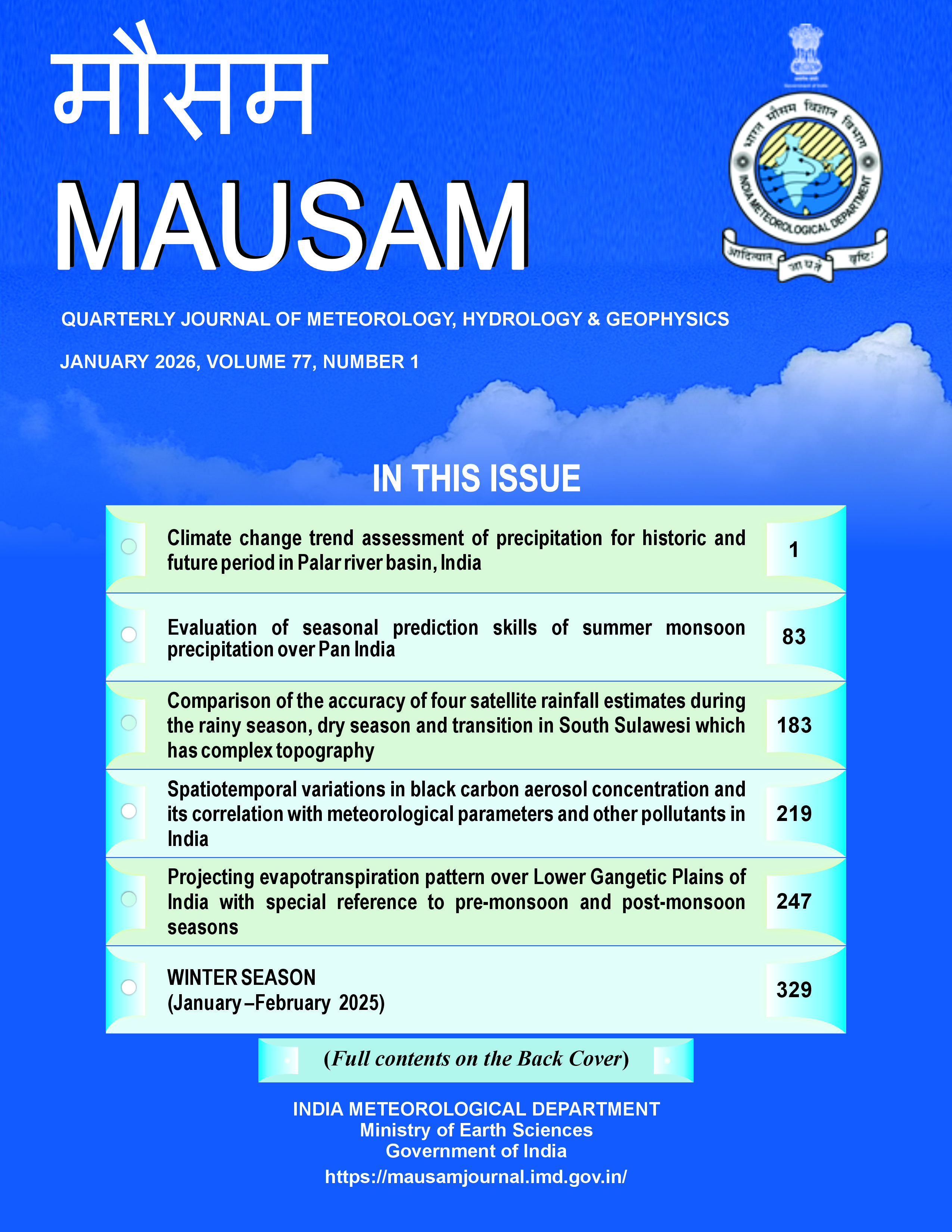
Projecting evapotranspiration pattern over Lower Gangetic Plains of India with special reference to pre-monsoon and post-monsoon seasons
DOI:
https://doi.org/10.54302/17rh9b48Abstract
Future predictions of potential evapotranspiration (PET) and rainfall are important factors that play pivotal role in effective crop planning and management. In this study, ensembled results of three Global Circulation Models (GCMs) were used to evaluate the changes in future PET and effective rainfall (ER) of the Lower Gangetic Plain (LGP) in India for two time slices: mid-century (2030-2040) and late-century (2070-2090) using two Representative Concentration Pathway (RCP) scenarios (RCP 4.5 and RCP 8.5). The MarkSim DSSAT Weather File Generator was used to downscale the climate projections. Temperatures, solar radiation, and rainfall simulated by the model majorly increased over the century, with slight decadal variations. The ensemble total PET for all stations combined has been projected to increase at the rate of 2.02 mm per year for 2030 - 2050 and 0.88 mm per year for 2070 – 2090 under RCP 4.5. Under RCP 8.5, the same is as high as 2.29 mm per year for 2030 - 2050 and 3.02 mm per year for 2070 – 2090. The highest monthly PET is recorded in May. Despite large variation in rainfall within decades, RCP 4.5 showed an overall increasing trend (approximately 5.5%), whereas RCP 8.5 showed a decreasing trend. Kalyani (New alluvial zone) demonstrated maximum decline in PET (22.38%) by late century (RCP 8.5) compared to other stations. Over the projected timeframe, "ER - PET" value will decrease, indicating a high demand for irrigation water. The results provided valuable insights into the economic planning of crops to support optimum production.
Downloads
Downloads
Published
Issue
Section
License
Copyright (c) 2026 MAUSAM

This work is licensed under a Creative Commons Attribution-NonCommercial 4.0 International License.
All articles published by MAUSAM are licensed under the Creative Commons Attribution 4.0 International License. This permits anyone.
Anyone is free:
- To Share - to copy, distribute and transmit the work
- To Remix - to adapt the work.
Under the following conditions:
- Share - copy and redistribute the material in any medium or format
- Adapt - remix, transform, and build upon the material for any purpose, even
commercially.


