
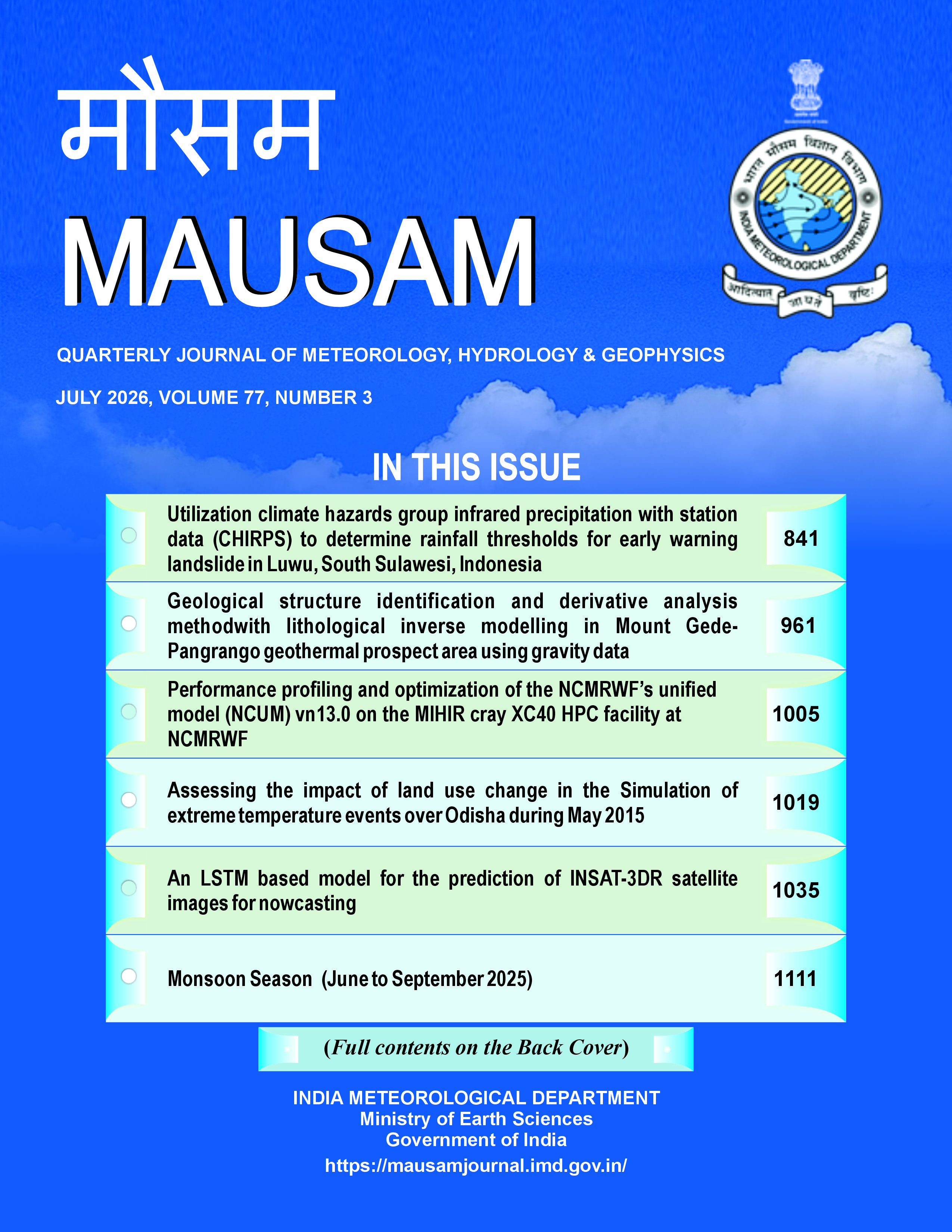
Geological structure identification and derivative analysis methodwith lithological inverse modelling in Mount Gede-Pangrango geothermal prospect area using gravity data
DOI:
https://doi.org/10.54302/mausam.v77i3.7172Abstract
The geothermal prospects of the Gede–Pangrango volcano complex in West Java, situated along the Pacific Ring of Fire, exhibit significant potential indicated by surface manifestations such as solfataras, fumaroles, and hot springs. Previous studies have reported the presence of a high-temperature reservoir (290–300°C) within Quaternary volcanic rocks at depths of 2000–2800 meters; however, uncertainties remain regarding the subsurface structures and faults that control the geothermal system. This study employs satellite-derived gravity data (GGMPlus) and elevation data (ERTM) to investigate these features. Edge-detection filters, including the First Horizontal Derivative (FHD) and Second Vertical Derivative (SVD), were applied to delineate subsurface structures associated with geothermal activity. The residual anomaly map reveals three primary zones: high, moderate, and low anomalies. High anomalies are concentrated around Mount Gede and Mount Pangrango, reflecting dense volcanic rocks or shallow intrusions, whereas low anomalies correspond to pyroclastic deposits and hydrothermally altered rocks. FHD and SVD analyses highlight northeast–southwest (NE–SW) trending faults that serve as primary pathways for geothermal fluid migration, confirmed by the alignment of fractures with hot springs and the Kawah Ratu crater. The 2D cross-sectional model indicates a low-density reservoir at depths of 1–2 km controlled by a major fault, underlain by intrusive rocks acting as the heat source. Furthermore, the 3D density modeling demonstrates a connected geothermal system between Mount Gede and Mount Pangrango, characterized by high-permeability zones beneath both volcanoes.
Downloads
Downloads
Published
License
Copyright (c) 2026 MAUSAM

This work is licensed under a Creative Commons Attribution-NonCommercial 4.0 International License.
All articles published by MAUSAM are licensed under the Creative Commons Attribution 4.0 International License. This permits anyone.
Anyone is free:
- To Share - to copy, distribute and transmit the work
- To Remix - to adapt the work.
Under the following conditions:
- Share - copy and redistribute the material in any medium or format
- Adapt - remix, transform, and build upon the material for any purpose, even
commercially.


